
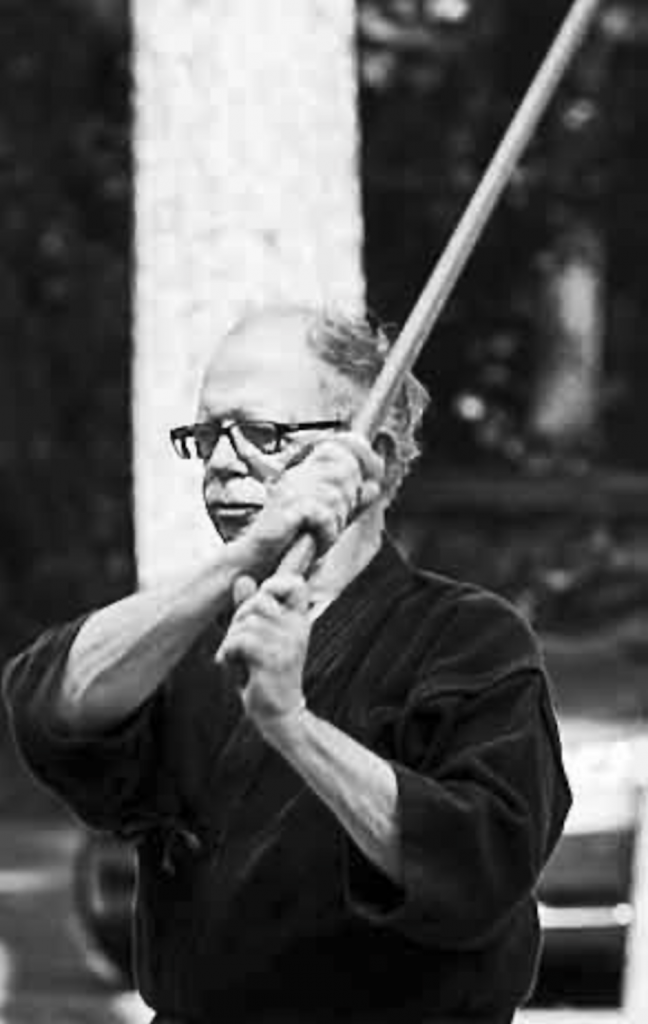
Summer grasses,
Where warriors dream
Basho (Rexroth translation)
David Hall, a senior member of the Shindo Muso ryu, passed away on July 26 of this year. He was a great friend, teacher, and advisor. Because of his inherent generosity and a gift for networking, I believe he was some or all these things to many others in the broader Western koryu community. Each gets their own experience of David, and their own assessment of him as a person. I want to share some of my thoughts about a man that I considered a mentor and model for his balancing of budo with scholarship. Dan Pearson
I don’t remember when I first heard of David Hall, but it was probably late 1995 or early 1996. It is almost a certainty the news got to me through some post on the old iaido-list. The post would have noted that Hall had settled in the D.C. area (where I was living) and would be offering training in Yagyu Shinkage ryu, Jiki Shinkage ryu, and Shindo Muso ryu. While I was intrigued, I already had my own ties to Kaminoda Sensei, who was teaching me his Shindo Muso ryu and iaido–so I was not in the market for a teacher or a new art. Still, I was amazed that the tides of fate would wash a swordsman from two schools of the Shinkage ryu tradition virtually to my doorstep; I watched for signs of David’s activities with anticipation.
Over the years, I drifted into closer and closer contact with David. First, we would find ourselves in proximity to each other through our respective groups doing public enbu around the D.C. area. Then David began co-hosting all-styles gatherings with his friend, the irascible John Quinn (another giant who also passed within the last year–if you never saw John throw shuriken you missed something special). Then David and I began just chatting on the phone, e-mailing, and meeting for an occasional coffee or meal.
Somewhere in that time I also met his two sons: Ian and Harding. Their fine characters confirmed my instincts that David was a good one. I admit that judging a parent by the qualities of their children can be misleading–it could just be chance that they were both good men and promising budoka (or, in this case, more due to their Mother’s influence)–but it reinforced my trust in David.
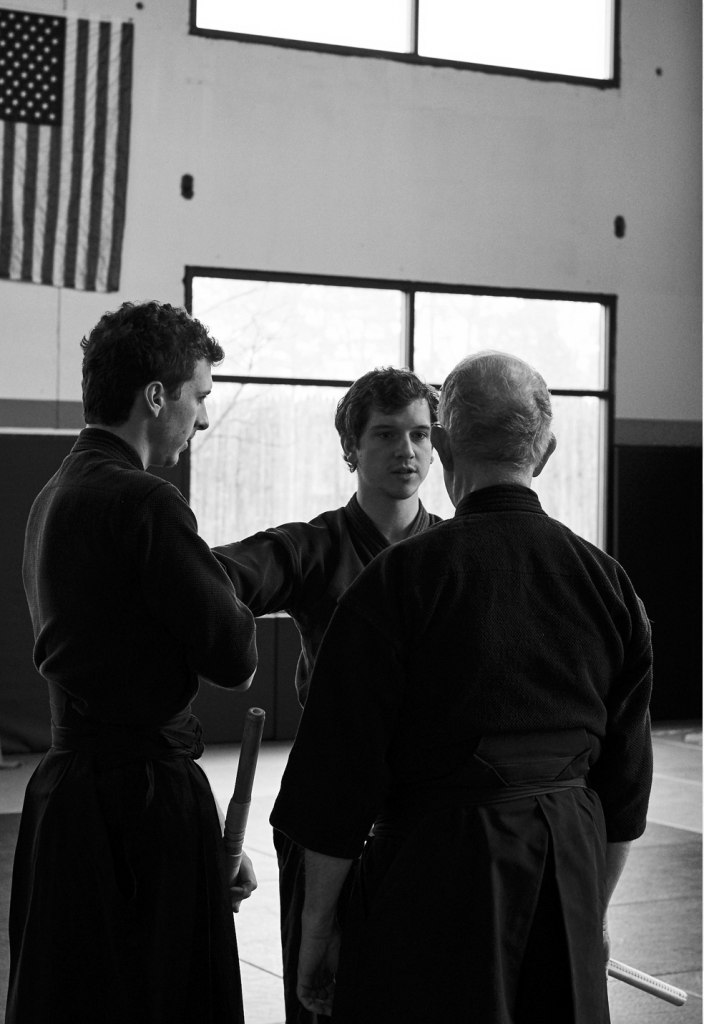
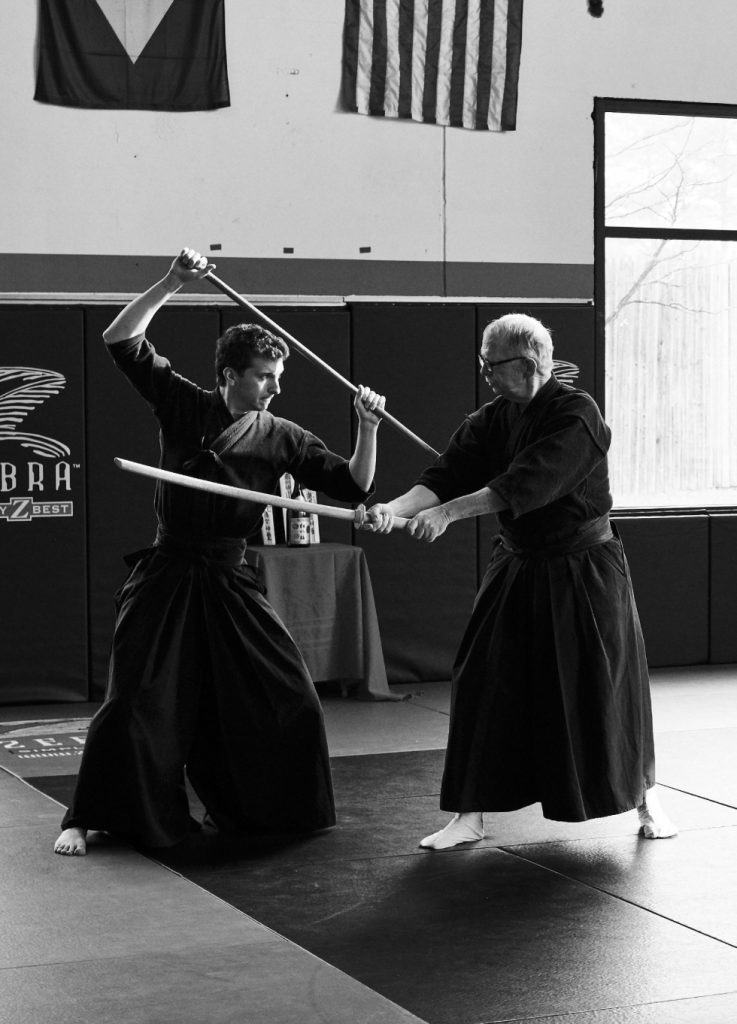
In the last ten years, after the passing of my teacher, I found myself turning more and more to David for insight and advice. Questions were bubbling up in me about Shindo Muso ryu’s (SMR) history and my Sensei was no longer there to give me guidance. David became one of the few people I could rely on to throw light into the dark SMR corners I had started to explore. In the process of those contacts I became quite close to David, and it was during this time that I realized he had become a friend and mentor.
We had a lot in common. We both had Ph.D. training with an emphasis on bringing a historical perspective to our work. This professional training built a desire in us to move beyond oral history and anecdote to documentation (which is not to say that oral history and anecdote are useless) in our understanding of our art’s history. We were both experienced practitioners of jojutsu and neither of us were in the most common North American SMR line–David identified as being a Draeger student and I was a deshi of Kaminoda Sensei. Neither of us had any interest in modern ZNKR-based seitei jodo. Both of us were immersed in a search for a deeper understanding of SMR’s traditions, kata, and applications.
What we didn’t have in common also tied us together. He had started his jodo in the Shimizu era and continued on in Japan during the 1980s when it was difficult for foreigners to get consistent training in Japan following the passing of Shimizu and Draeger Sensei. I had started jodo in 1995 with Kaminoda who, by that point, was very open to taking on and promoting foreign students. This meant that David and I could fill each other in on missing parts of modern koryu jojutsu, bridging two generations of training with top teachers in the Tokyo-line of SMR through our discussions and occasional crossing of weapons.
David’s Shindo Muso ryu was very much in the style of late-1970s and early-1980s Tokyo jo–which you would expect of someone who trained during Shimizu’s last years and identified as a Draeger student. That was the flavor of his waza, and I was already familiar with it from the older members of my Sensei’s group. My style tended to reflect the evolution of Kaminoda’s teachings and understanding of waza and rigo as captured in the last 20 years of his 60 year budo career. David and I could easily train together, noticing the small differences as we went, and each could explain why we did what we did. Those experiences were educational and exhilarating.
A committed martial artist with a stable of fine students learning his three arts, David combined this passion with his deep commitment to scholarship. He had been touched with Draeger’s fire for hoplology. Draeger gave form and energy to a broad effort by martial artists to sink into martial forms, documenting them almost as reports from the field as an anthropologist might. Martial arts became more than just ways of learning to fight or to master yourself, but also vehicles for understanding the histories and cultures of martial training, charting different “languages” of self-defense and aggression.
David’s best known scholarly work in the Draeger vein is probably his Encyclopedia of Japanese Martial Arts, which tackles the impossible task of identifying key figures, central concepts, and notable schools across the entire history of Japanese martial ways. Did he get it all right? I can say that his entry on my teacher has some errors, and I know he had been told of other “mistakes” that he hoped to correct in the (probably apocryphal) 2nd edition. Despite the small mistakes, there is real value and broad erudition that will improve anyone’s ability to think and talk about Japanese martial ways. Get a copy if you don’t have it already!

His most important work came out of his doctoral dissertation on the Buddhist deity Marishiten (Sanskrit, Mārīcī-devi). David’s work on Marishiten and the psychology of Japanese warrior preparation is a highly sophisticated hoplological effort blending history, religion, and insights from (and for) koryu training. You can find his dissertation still, but he conveniently revised it and published it as The Buddhist Goddess Marishiten: a study of the evolution and impact of her cult on the Japanese warrior. In this work Hall elaborates on his very useful framework of volition, cognition, and an imperturbable mind as the three central qualities developed through koryu training.
Remarkably, David took implications from his scholarship to create a focused effort to support American soldiers returning from war. Psychological insights from his studies of koryu practices led David to establish jodo-based classes for soldiers returning from Afghanistan and Iraq. A veteran himself, he offered a PTSD-management course in association with Walter-Reed National Army Hospital. His effort to take deep lessons from koryu for managing exposure to stress and apply those lessons to the needs of modern warriors coping with reentering peaceful society was truly inspiring.
Hilarious and witty, I never knew David to be cruel or unfair. He held strong opinions about waza and rigo, but was also open to alternative approaches and exploration. With enough time he would forgive mistakes by his friends, even if he did not forget them. David was a gentleman who treated everyone as worthy of his time and attention–at least until you proved otherwise. Generous and supportive of others working to gather information about SMR, he was widely connected across the art in his own effort to collect as much information regarding our ryu as he could. His research effort made David a sort of “cross-roads” for non-Japanese interested in SMR and he linked many of us together (even if we didn’t always know it!).
After more than 30 years of teaching koryu arts, David leaves many very polished students to continue his Jiki Shinkage ryu, Yagyu Shinkage ryu, and Shindo Muso ryu. He was also actively compiling a history of Shindo Muso ryu, though it was not near completion. Efforts there led to his last academic publication discussing the Ikkaku ryu juttejutsu densho issued by Hirano Kichizou to Uchida Ryogoro. Appropriately for David, that article was published in Japanese (link below; you have to download the 2023 museum annual report and you can find David’s article on pages 71-73.)
https://www.meiji.ac.jp/museum/annual/6t5h7p00000curqk-att/annual2023.pdf
Husband, father, veteran, scholar, martial artist, author, raconteur, wit, musician, Tendai priest, and loyal friend–the Shindo Muso ryu (and koryu) world has lost a source of light, but David Hall Sensei’s inspiration will continue to guide us downstream.
The ryu carries on.
Pingback: generic cialis pills
Pingback: semaglutide vs tirzepatide structure
Pingback: semaglutida para que serve esse medicamento
Pingback: semaglutid naturligt
Pingback: propecia 1mg amazon
Pingback: is tadalafil expensive
Pingback: rogaine amazon prime
Pingback: ketorolac for migraine
Pingback: toradol short term clinical guidance
Pingback: sildenafil food‑linked absorption delay
Pingback: sildenafil biochemical pathway
Pingback: avanafil food interaction context